
BeneMeat: Europe Needs Less Bureaucracy and More Room for Innovation
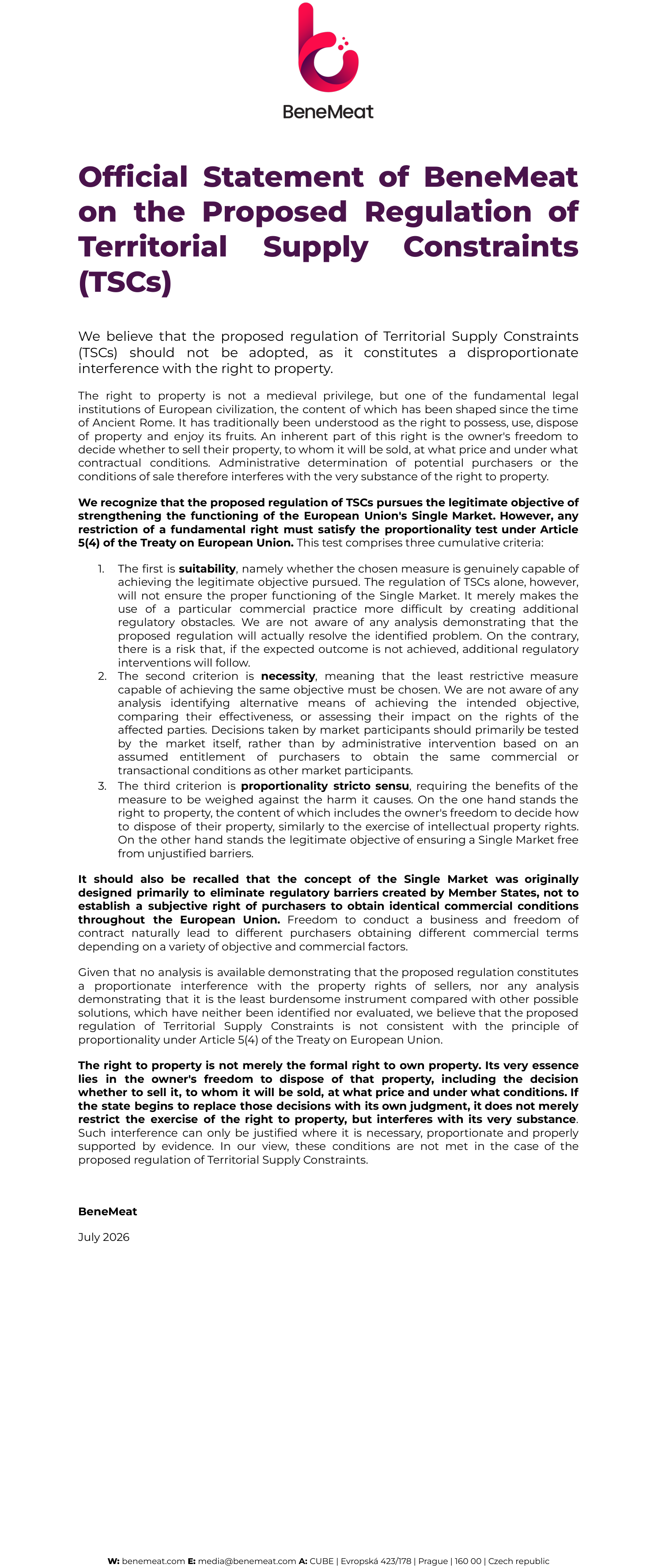
BeneMeat has provided its position on the European Commission's proposed regulation on Territorial Supply Constraints (TSCs). While the proposal addresses a specific aspect of the European Single Market, we believe it also highlights a much broader issue, the growing regulatory burden that increasingly limits the ability of innovative European companies to grow.
Small and medium-sized enterprises (SMEs) are the backbone of the European economy and the driving force behind many of its innovations. Yet they are also the businesses most affected by increasingly complex regulatory requirements. Time, financial resources and expert capacity that could otherwise be invested in research, development and international expansion are instead consumed by administrative compliance.
"Europe is home to world-class scientists, talented entrepreneurs and outstanding technologies. However, if we want today's startups and innovative SMEs to become tomorrow's global leaders, we must create an environment that enables them to grow. Excessive regulation rarely poses the greatest challenge to large corporations with extensive legal and compliance teams. Instead, it disproportionately affects small and medium-sized businesses that simply do not have the resources to absorb an ever-growing administrative burden," says Roman Kříž, CEO of BeneMeat.
The proposed regulation on Territorial Supply Constraints is one example of this broader trend. BeneMeat fully supports the objective of strengthening the European Single Market. At the same time, we believe that any restriction of fundamental rights, including property rights and freedom of contract, must be properly justified, necessary and proportionate.
Europe's long-term competitiveness should not depend on introducing additional administrative obligations, but rather on removing unnecessary barriers to entrepreneurship, encouraging innovation and creating a predictable regulatory environment. Only then can European companies successfully scale, compete globally and grow into the industry leaders of the future.
BeneMeat's full position on the proposed Territorial Supply Constraints regulation is available in the attached PDF statement.
BeneMeat
BeneMeat is a biotech company, part of the BTL Group, focused on developing scalable and efficient cultivated meat production technology. Since 2020, the company has developed deep, end-to-end expertise across biology, chemistry, hardware, software, and commercial implementation of cultivated meat. With 150+ R&D experts, BeneMeat is building the complete technological ecosystem, from versatile cell line development to scalable, reliable, and cost-effective manufacturing solutions. The company is prepared to support manufacturers through all the key challenges of bringing cultivated meat to market: technical, legal, regulatory, and commercial. BeneMeat is the first in the EU to be registered as a producer of cultivated meat for pet food (Autumn 2023), proving our regulatory leadership in this space. “We are not just another company in cultivated meat, we are the technology partner shaping its future.”
For more information, contact: media@benemeat.com