
Czech Breakthrough in Cultivated Meat: Study in Prestigious Scientific Journal Confirms Environmental Benefits
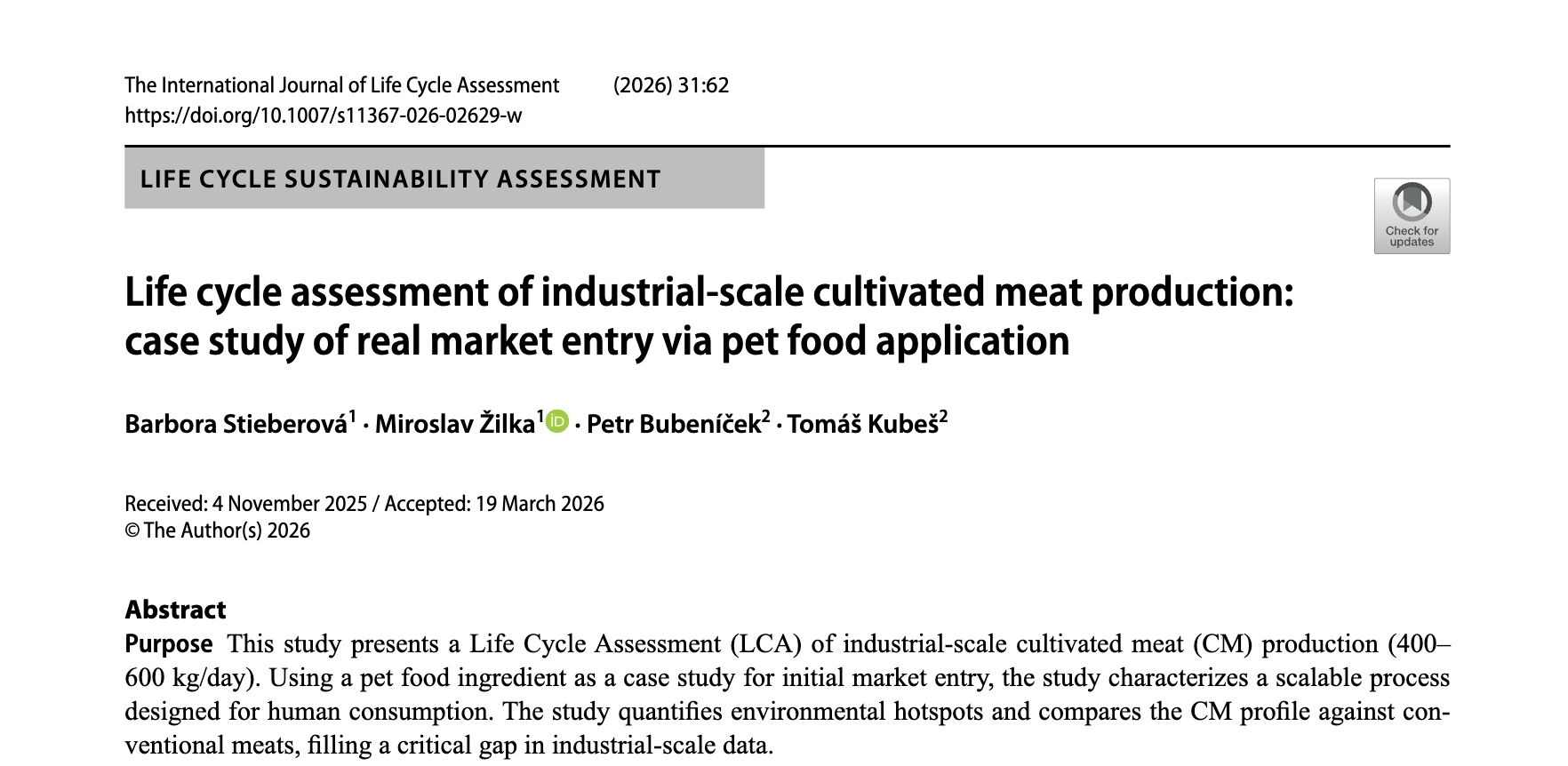
The Czech biotechnology company BeneMeat and the Faculty of Mechanical Engineering at the Czech Technical University in Prague (CTU), has published a groundbreaking study on the environmental impacts of cultivated meat. The research was featured in the prestigious peer-reviewed journal The International Journal of Life Cycle Assessment. As one of the first in the world, it is not based on lab data and rough estimates, but on primary data from our pilot process and detailed models of a real-world industrial plant.
The published article, titled “Life cycle assessment of industrial-scale cultivated meat production: case study of real market entry via pet food application,” provides a comprehensive Life Cycle Assessment (LCA). Unlike previous estimates based on laboratory tests, this study works with primary data from pilot production and models of the upcoming industrial operation. The analysis is based on technology designed for a production capacity of 400–600 kg of meat per day, offering a more accurate and relevant perspective on the environmental footprint of cultivated meat in commercial production.
Results indicate that large-scale cultivated meat production can achieve comparable or lower environmental impacts than conventional meat, with the choice of raw materials and energy mix being crucial factors. “The goal was to align the environmental impact assessment with the real conditions of future production. Using primary data from the industrial process allows us to significantly refine previous estimates and provides a vital reference framework for further development in the field of cultivated meat,” says Miroslav Žilka, Ph.D., Head of the Department of Management and Economics at CTU and co-author of the study.
The analysis shows that the current carbon footprint is 5.3 kg CO2 eq. per kilogram of product, which is lower than that of conventional beef or pork. Furthermore, identified optimization steps can reduce this value to just 3.3 kg CO2 eq., bringing cultivated meat below the footprint of European conventional chicken production. The energy intensity of production currently stands at approximately 66 MJ per kilogram, with the potential to decrease further to 61.5 MJ.
“For BeneMeat, it is essential to work with real data. This study clearly demonstrates that our technology has the potential to succeed in industrial production from both a technological and environmental standpoint,” says Jan Luprich, Business Development at BeneMeat. This publication is only the beginning for BeneMeat. The company is already planning a follow-up analysis based on data from full-scale operations. This future work will provide definitive verification of the results in practice and offer the most precise view yet of the environmental footprint of cultivated meat in full commercial deployment.
The full article is available for reading and download via Open Access at: https://rdcu.be/fcbxE
Cultivated meat
Cultivated meat, also known as cultured meat or cell-based meat, is real animal meat produced by directly growing animal cells in a controlled environment instead of raising and slaughtering animals. The process begins with a small sample of animal cells, which are nourished with essential nutrients and guided to form muscle, fat, and connective tissue, replicating natural biological growth. The result is meat that is biologically identical to conventional meat but can be produced more sustainably, with lower environmental impact and improved animal welfare. A term Cultivated meat refers to meat (including muscle cells, fat cells, connective tissue, blood, and other components) produced by cultivating animal cells, not by slaughtering a live animal. (Source: New Harvest – a research institute that aims to accelerate progress in cellular agriculture).
BeneMeat
BeneMeat is a biotech company, part of the BTL Group, focused on developing scalable and efficient cultivated meat production technology. Since 2020, the company has developed deep, end-to-end expertise across biology, chemistry, hardware, software, and commercial implementation of cultivated meat. With 150+ R&D experts, BeneMeat is building the complete technological ecosystem, from versatile cell line development to scalable, reliable, and cost-effective manufacturing solutions. The company is prepared to support manufacturers through all the key challenges of bringing cultivated meat to market: technical, legal, regulatory, and commercial. BeneMeat is the first in the EU to be registered as a producer of cultivated meat for pet food (Autumn 2023), proving our regulatory leadership in this space. “We are not just another company in cultivated meat, we are the technology partner shaping its future.”
For more information, contact: media@benemeat.com